Hi, I’m Nikola.
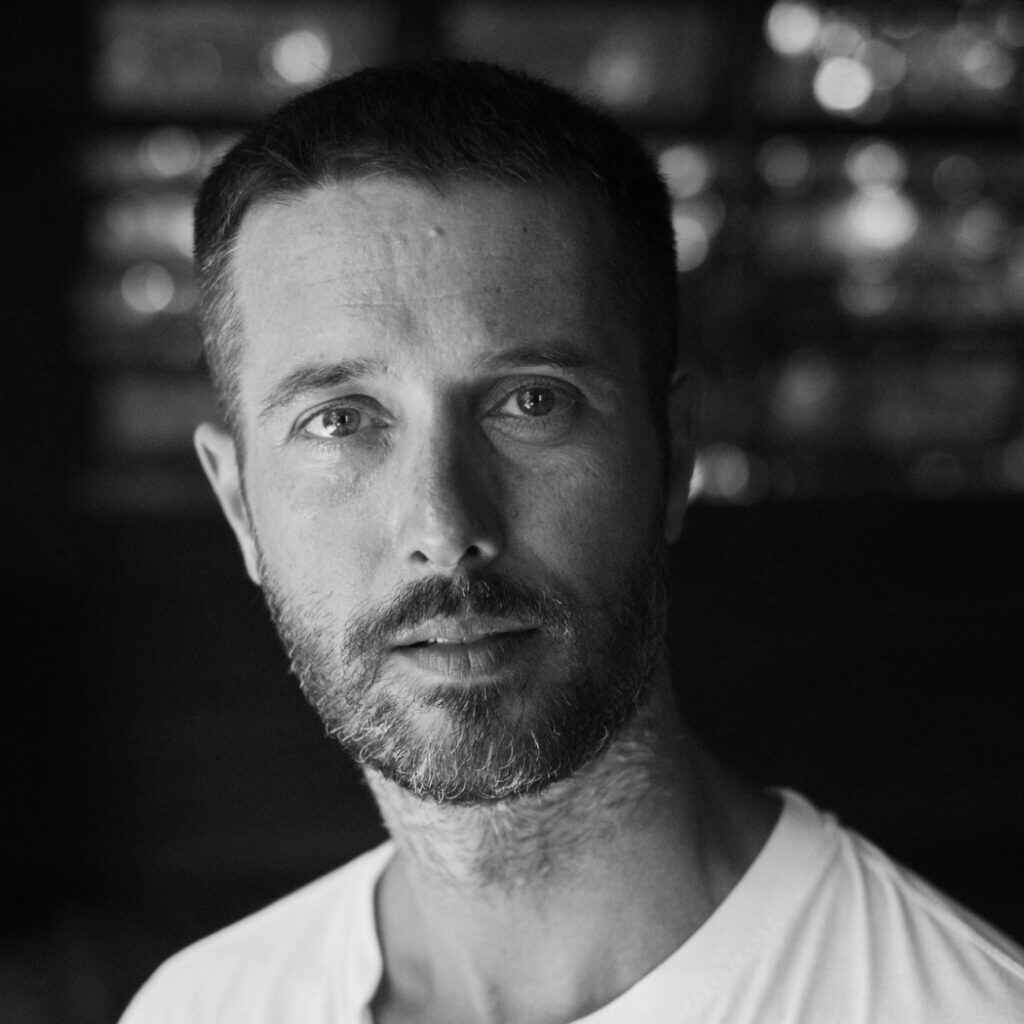
I help people feel more at home in their bodies.
For over fifteen years, I was a technology entrepreneur. Long hours at a screen, building, coding, designing, negotiating. Creative work, but all of it happening inside my head. I had kept a meditation practice since my early twenties and was drawn to spiritual questions. But even that was happening above the body, not through it. The body just wasn’t part of any of it.
Somehow the searching brought me to India. One February in Goa, I walked into a contact improvisation dance class. It was challenging, completely unlike anything I knew how to do. But I felt something true in it, and something else: a sense that this was exactly where I needed to be. Scary and completely clear at the same time.
I kept going back. Even when it was uncomfortable, I kept going. It became the center of my life for a while. I started traveling to contact improvisation festivals, one after another. And through that world I began finding something wider: teachers of bodywork and healing arts, different ways of working with the body.
Over the years that followed, I kept traveling, between continents and also through layer after layer of whatever I’d been carrying without knowing it. I found teachers and methods, each one offering a different way into the same territory: the body as a living, intelligent process worth actually listening to.
I’m still on that path.
Why I do this
I didn’t come to this through a clinical background. I came through my own long confusion and the slow process of finding my way back.
For years I thought I could understand my way to freedom. I couldn’t. Understanding wasn’t what shifted things. Something else did: something more direct, more physical. That is what I work toward with other people.
In my sessions this means we work with movement and with what comes up emotionally, following what your body brings. You decide the mix, and it can change from week to week.
Where I am
My home base in Europe is Belgrade, Serbia. In the winter you’ll find me in Koh Phangan, Thailand. All one-on-one sessions are online, and I teach group classes worldwide.
Background & Training
- Feldenkrais Method
- Biodynamic CranioSacral Therapy and Upledger CranioSacral Therapy
- Hanna Somatics
- Transforming Touch – Developmental Trauma Enhancements
- NeuroAffective Touch
I keep studying. Right now I am in my third year of Aletheia Coaching and also in the Animism & Earth Ritual Practitioner Training.
I’ve noticed that whatever I’m working through in myself tends to quietly show up in how I sit with someone else. That’s reason enough to keep going.
One question I keep returning to, in my own practice and in this work:
How do we find our way back to ourselves?
My work brings together evidence-informed somatic education, nervous system-based bodywork, trauma-informed touch, depth coaching, and earth-based practice.
Some of these methods are grounded in motor learning, anatomy, and neuroscience. Others come from therapeutic, contemplative, and ancestral traditions.
All of them share a respect for the body’s intelligence and its capacity to find its own way back.
In sessions, you choose the focus. Earth-based practice is part of a session only if you ask for it.
The modalities I work with
Feldenkrais Method
Moshe Feldenkrais was a physicist and judo expert who built a method around the body’s capacity to learn. Slow, gentle movement with directed attention shows the nervous system what else is possible, and old habits of bracing and compensating begin to loosen. For more than 75 years it has been used by physiotherapists, rehabilitation centers, musicians, dancers, actors and athletes.
Biodynamic CranioSacral Therapy
One of the gentlest forms of bodywork. Through very light touch it follows the slow, tide-like rhythms of the body and supports a pause in which the nervous system can settle. It draws on osteopathic medicine and the work of William Sutherland. Many people describe a deep kind of rest during this work.
Hanna Somatics
Thomas Hanna described Sensory Motor Amnesia: muscles that have learned to stay contracted after stress or injury. His technique, pandiculation, is a slow, conscious contraction followed by a very slow release. The movements are simple enough to practice on your own between sessions.
Transforming Touch
Developed by Stephen Terrell for the imprints of developmental trauma: overwhelm or unmet needs from before we had language. It works through gentle touch in a specific sequence, for the kind of background anxiety that insight and talking did not move.
NeuroAffective Touch
Developed by clinical psychologist Dr. Aline LaPierre, drawing on affective neuroscience, attachment theory and somatic psychotherapy. It works with the earliest layer of experience, which arrives through touch before words, and with the sense of not quite being here that many people carry without a name for it.
Aletheia Coaching
Developed by Steve March as a depth-coaching method. It works through four layers: parts work drawing on Internal Family Systems, somatic and process work, presence practices, and nondual inquiry. It suits people who are already self-aware and find that insight alone keeps meeting the same walls.
Animism & Earth Ritual
Animism is the worldview held by most human cultures throughout history: that the world is alive, and that land, water, plants, animals, and ancestors are living presences with whom we are in relationship. Earth ritual practices are the practical disciplines through which that relationship is built, maintained, and repaired. This work, developed through Daniel Foor’s Ancestral Medicine, offers grounded, culturally sensitive practices for reconnecting with the living world: learning to listen to place, to honor lineage, to find again a sense of belonging that extends beyond the personal. Much of what troubles people today (the loneliness, the disconnection, the ecological grief, the vague sense of uprootedness) has roots in the severing of this larger relational web. Individual healing alone will not fully address it. For those drawn to this dimension, it offers a serious and grounded path back.
All of these approaches can be adapted for online sessions.
Stay connected
Get notified about upcoming classes and offerings.
Join the quiet WhatsApp group for occasional announcements, or follow along on Instagram.